There's this famous meme floating around:
"I want AI to do my laundry and dishes so that I can do art and writing, not for AI to do my art and writing so that I can do my laundry and dishes."
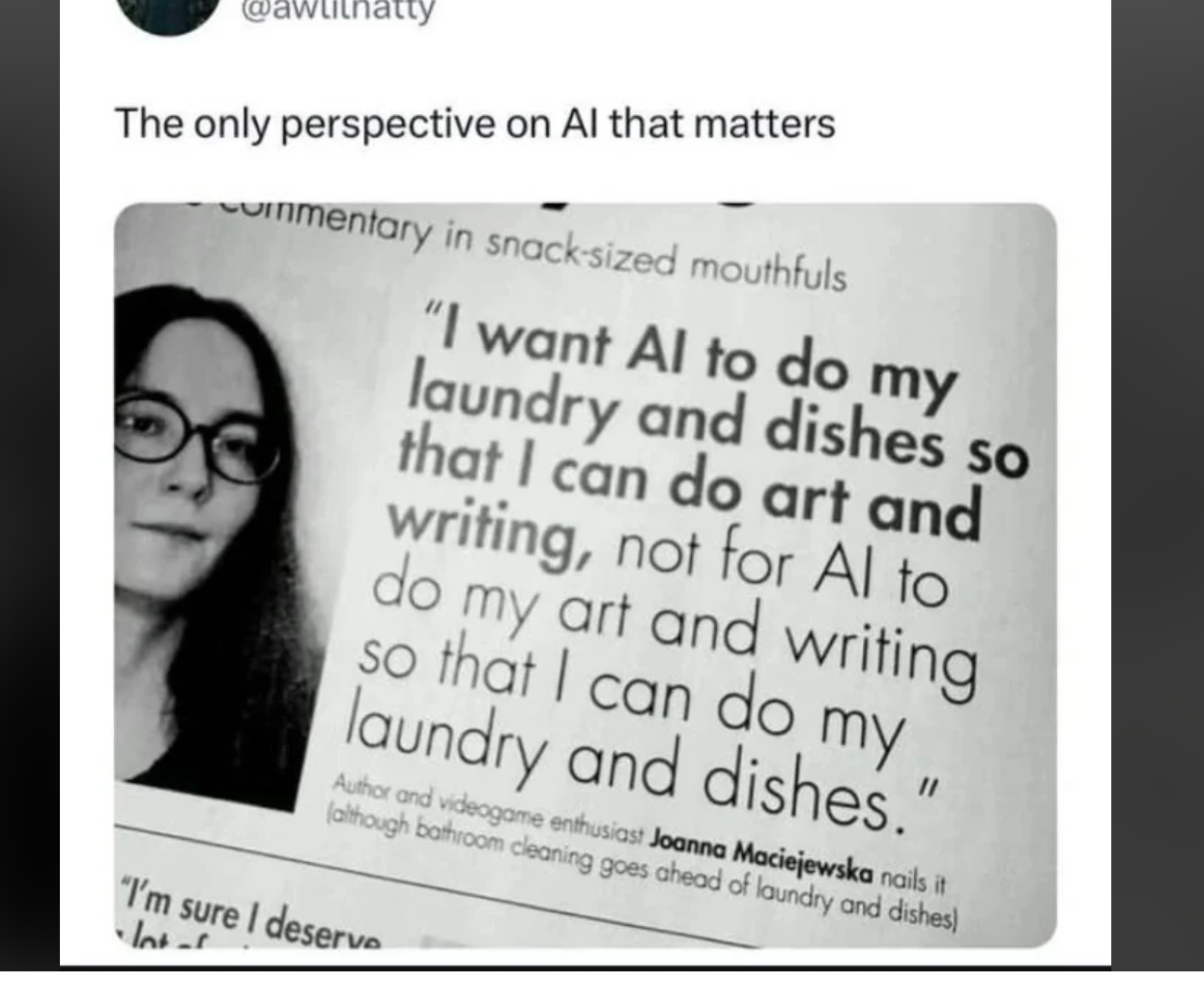
I, like so many others cheered upon seeing that. But then I realised things are more complicated.
The thing is, "AI" has been doing our laundry and dishes for centuries. The first patent for a washing machine was issued in 1691 and sales of electric washing machines reached 800 000 in the States already in 1928. The first mechanical dishwasher was patented in 1850 and our modern conception of one probably goes back as far as the late fifties.
These are not strictly-speaking AI systems, but they don't need to be. They still "do our laundry and dishes". I would even argue that modern-day versions of these appliances tend to look more like computers with some washing bits bolted on. With all the associated issues of repairability and security. I'm sure there's ones already out there with actual "AI" features baked into them.
So why did we all cheer when we saw that quote? I think our reaction reveals some profound contradictions in our relationship with technology.
First, we tend to disregard established technology as technology. The humble dishwasher and washing machine are both the result of centuries (if not millennia) of technological, social and economic progress. You can't have washing machines before you have mining, metallurgy, electric generators and motors, an electrical grid, indoor plumbing, water treatment, sewage systems, plastics, global supply chains, advanced chemicals and semiconductors. Not to mention an economic middle class large enough to sustain the economies of scale needed to produce these machines at prices people can actually afford. All of these things have increased our quality of life tremendously giving us access to comforts not even seen by kings just some centuries ago. I would also argue that their combined benefits for humanity vastly outweigh whatever LLMs have to offer. And yet here we are, seemingly oblivious to their existence.
Second, when time-saving appliances such as the washing machine are introduced into our daily lives, their-time saving effects are - at best - temporary. We don't actually "do art and writing" while the machine does our laundry - we watch videos or browse online stores for washing machines. The potential time-saving benefit of the appliance used to be our rationalisation for buying one, but we don't even do that anymore. Most likely because very few families in the developed nations still do their laundry by hand. We don't actually save any time for meaningful activities because we no longer see the dishwasher, the washing machine or the vacuum cleaner as time-saving devices. Doing so would require a conscious, disciplined effort and most of us just aren't very good at that stuff.
And lastly, we seem to want more and less of technology at the same time. This one has been brought into particularly sharp focus by the AI revolution. We want "AI", but we don't want it to encroach on activities we care about. When we say "I want AI to do my dishes" we are effectively talking about something (almost said "someone") that would put the dishes into the machine - in other words, a humanoid robot - which, I'm sure most would agree - is a very different message from the one the meme originally carried.
We want a global social media platform without having to deal with diversity of opinion, human stupidity or bad manners. We want to use these services for free without dealing with the toxic business models and constant surveillance that make them "free". We want the recommendation alorithm to promote our anti-AI rant while suppressing our neighbors' against immigration. We want a constant 24/7 dopamine drip of entertainment and "news", but not the resulting addictions. Smoking without the fire, sweets without the sugar, learning without the effort, automation without the deskilling - all seemingly just one more clever invention away from becoming reality. Any social ail caused by technology solved by even more technology.
We can't have it both ways. At some point, we have to make some actual sacrificies because it's the right - and not just the more convenient - thing to do.